Beyond the Weeping Woman By Terry Ehret
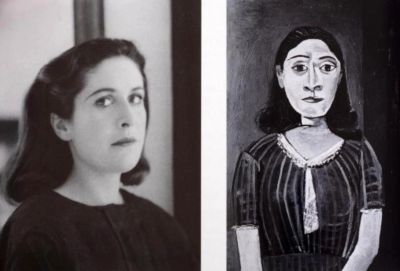
Beyond the Weeping Woman
Dora Maar, 1942
He can wholly possess her only as long as she fits into
the picture
that his imagination is always arranging.
−Jaime Sabartes and Wilhelm Boeck, Pablo Picasso
I hold my hand in my hand
below the frame
things are in place—so, just so.
Here is the dress I have always worn. Here is my hair, my
mouth,
my jaw, my arms like two schoolgirls
awkward and fixed agains my side
as if they ought not to be there at all,
having no business being there at all.
73“This part of the painting will be black” he says,
bending my elbow to fit a little
more into the lower edge. “It will be
dark, even monstrious, and you will not like it there.
On your forehead a furrow above the eyebrow
because w hen you look, there is an absence you want to
fill
and it makes you very proud, very vulnerable—nothing
dangerous.
“The death of your father sits
behind you
on the wall that is gray. It
moves
up from the floor in the lines of
your dress,
over your breasts. But see, I
will paint here a white collar
for you, white with a lace edge,
because if I
were to take it away now not even a
red hat would keep you from breaking into
angles, your teeth clenched in your hand,
your eyes the eyes
of birds of prey.”
I wrote this ekphrastic poem almost 40 years ago, based
on two portraits by Pablo Picasso of Dora Maar (Henriette
Theodora Markovitch). I didn’t know much about Maar,
only that Picasso claimed she was a nervous and troubled
creature, prone to fits of weeping. But there was
something in the way Picasso had arranged hismodel/muse/lover that made me bristle at his manipulation
and identify with Dora Maar’s underlying rage—a rage his
painting couldn’t tame.When Dora Maar died in Paris in
1997, the art world that had previously known her as
Picasso’s mistress began to recognize the scope of her
legacy as a surrealist painter, photographer, and political
activist who both threatened and inspired Picasso. About
the “weeping woman” name he gave her, and his
characterization of her in his portraits, Maar said, “All his
portraits of me are lies. They're all Picassos. Not one is
Dora Maar.” Her fits of weeping may have symbolized to
Picasso the zeitgeist of the 1930s and 40s, but it was
Maar’s politics that shaped his great anti-war mural,
Guernica. Prior to this, Picasso’s work didn’t have
political messages, but Maar, who was fiercely anti-
fascist, made sure Picasso kept the spotlight on what
mattered. And it wasn’t until he included Maar as the
weeping woman that the mural found its voice, its heart,
its outrage, and its power. In another ekphrastic poem in
75this series, I traced the evolution of Guernica (just as
Maar had recorded its evolution through her photographs),
and could see so very clearly how static the mural would
have been without her: “the weeping woman, who hasn’t
yet appeared/and her dead child will change//everything/
she will make the canvas scream.”
Guernica by Pablo Picasso, 1937
“Dora Maar, 1942” originally published in Lost Body
(Copper Canyon Press, 1992).
“The Thought She Might: Picasso Portraits,” Translations
from the Human Language (Sixteen Rivers Press, 2001)
Next Chapter