Elizabeth stoddard: Too Much, too soon, too strange by kim a
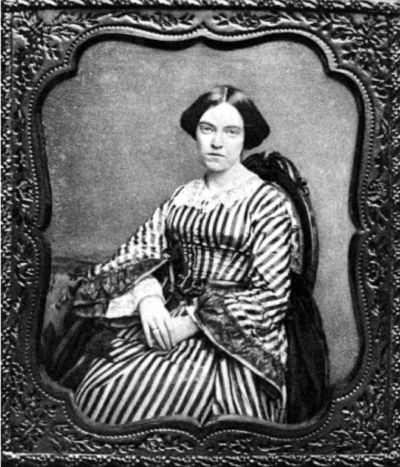
Elizabeth Stoddard: Too Much, Too Strange, Too Soon
Enigmatic much?
In five years of podcasting my co-host Amy Helmes and I
have covered some fascinating women writers, but I don’t
think anyone has haunted me more than Elizabeth
Stoddard. Something about her story and her first novel
The Morgesons has stayed with me and tugged at the
corner of my mind like a puzzle that I have yet to solve.
What is it about Stoddard? In her lifetime her work was
compared to Balzac, Tolstoy, Eliot, the Brontë sisters, and
Nathaniel Hawthorne. The latter was an admirer and so
was Henry James. She may have been a writers’ writer,
but her books didn’t sell very well. In her own words “I
think one copy [of The Morgesons] passed from hand to
hand, but the interest in it soon blew over and I have not
13been noticed there since.” It’s hard to believe once you’ve
read the novel. It’s both brilliant and bold. Some scholars
today consider her one of the most strikingly original
novelists of her time, next to Melville and Hawthorne.
Elizabeth Stoddard, born Elizabeth Barstow in 1823, grew
up in the New England coastal town of Mattapoisett, the
model for Surrey in The Morgesons. Like her heroine, she
was the granddaughter of a tailor and the daughter of a
shipbuilder, raised on the margins of a community where
her family’s financial instability set them apart. Despite
this, she received a strong formal education and was an
avid reader, counting the Brontë sisters among her early
literary influences. From a young age, she was known for
her temperamental nature.
That temperament is on full display in The Morgesons,
which announces itself from the very first line: “That
child,’ said my aunt Mercy, looking at me with indigo-
colored eyes, ‘is possessed.” It’s a startling way to
introduce a heroine. Cassandra is not simply spirited or
unconventional; she is willful, defiant, and uninterested in
conforming to moral expectations. As a child, she learns
she can evade punishment by pretending ignorance; as she
grows older, she continues to test boundaries with an
unapologetic intensity. She doesn’t smooth things over or
try to make herself more palatable. Instead, she can be
blunt, erratic, even difficult to understand. And the novel
doesn’t rush to explain her. Her motivations remain, at
times, elusive and her behavior unpredictable. It’s this
refusal to fully resolve her character, this sense thatsomething essential remains just out of reach, that begins
to explain why she lingers.
Part of what makes The Morgesons linger, though, is not
just Cassandra herself, but the way Stoddard tells her
story. The novel resists the conventions of its time.
Dialogue often appears without clear attribution, scenes
build toward emotional intensity only to break off
abruptly, and characters’ motivations are often difficult to
grasp. There is little sense that the reader is being guided
through the narrative. Instead, the prose feels jagged, even
disorienting, as one critic described it, “pointy and
angular.” In this way, the novel feels less like the moral
clarity of a traditional 19th-century bildungsroman and
more like something closer to Henry James, where
interiority takes precedence over explanation. The novel
doesn’t guide the reader so much as abandon her to the
experience, and like Cassandra herself, it resists
resolution.
And yet, for all its originality, The Morgesons barely
registered when it was initially published. The timing
didn’t help. It came out just days after the Union Army’s
defeat at Bull Run, as the country’s attention turned fully
to war. But circumstance alone doesn’t seem to account
for it. The novel occupies an uneasy space, perhaps too
psychologically complex to align with the moral clarity of
popular 19th-century fiction, yet too structurally unruly to
fit comfortably alongside its more experimental peers. In
many ways, it is a book without a clear literary home.
Perhaps it was precisely this refusal to conform, this
15resistance to resolution, this insistence on ambiguity, that
made it so easy to overlook and yet so difficult to forget.
It’s tempting to say that Stoddard was simply ahead of her
time. And in some ways, she was. The Morgesons is, on
the surface, a bildungsroman, a coming-of-age story, but
one that traces not just a search for identity, but for
autonomy and sexual fulfillment within a deeply
constrained world. That tension runs through the novel. It
draws on the brooding intensity of writers like Nathaniel
Hawthorne and Edgar Allan Poe, while also anticipating
the psychological ambiguity of Henry James. The result is
something difficult to place, neither fully aligned with the
moral clarity of popular fiction nor comfortably situated
among more experimental forms. Even its treatment of
female desire feels unusually direct, unsettling in ways
that resist easy interpretation. But being ahead of one’s
time is not always an advantage. Without a clear place in
the literary landscape, the novel had little to anchor it.
That may be part of what gives it its enduring power.
I still don’t think I’ve solved the puzzle of Elizabeth
Stoddard. Maybe that’s the point. There are writers whose
work settles into place once you understand it, whose
characters resolve and whose meanings clarify. The
Morgesons refuses that kind of closure. Cassandra
remains, even at the end, difficult to fully grasp; her
desires, her choices, her contradictions never quite cohere
into something easily explained. And the novel itself
behaves the same way, resisting the structures that might
make it more legible, more containable. Perhaps that is
why it lingers. Not in spite of its opacity, but because of it.Stoddard created something that doesn’t fully yield to
interpretation, and so it stays with you, unresolved, a little
unsettling, and difficult to forget.