Cochiti Potter Helen Cordero and the Storyteller Dolls: Inno
Cochiti Potter Helen Cordero and the Storyteller Dolls: Innovation and Contribution
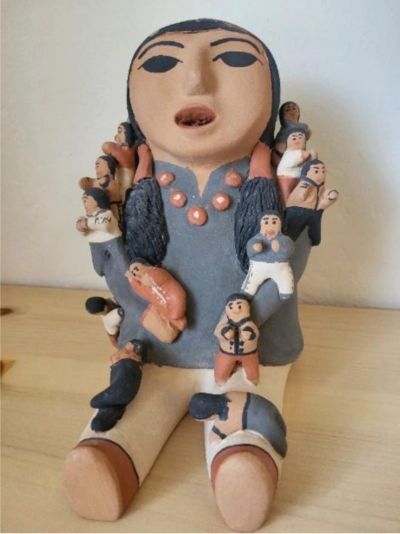
In February 2026, a compelling pottery figure caught my
eye in a San Rafael, California hospice thrift store and
came home with me. Just over seven inches tall, I
immediately recognized it as a “storyteller” doll from the
American Southwest. Open-mouthed, there are thirteen
children attached to the clay figure—some sleeping, some
crawling, some hanging on. On the bottom is the artist’s
mark—CLS, 1989 (year) and Jemez. A quick search
identified the maker as Caroline Loretto Seonia from the
Jemez Pueblo in New Mexico.. The origin of the
storyteller dolls is relatively modern, though based upon
ancient traditions. The Cochiti people of New Mexico had a
strong tradition of figurative pottery. For many decades, a few
Cochiti women made “Singing Mothers,” figurines with one or
two children. At age 45, Helen Cordero (1915-1994)
wanted to earn more money. She had raised
six children—her four children, and after her sister’s
death, her two nephews. Cordero began making jewelry
and leather work for sale with her husband’s cousin, but
the materials were expensive. Grandma Juana suggested
that they make pottery as the clay and pigments could be
dug from the earth. Materials were free, and the pottery
was fired using traditional techniques. Helen attempted to
make bowls, but they were lopsided, so she turned to
making small figures of clay.
In 1964, Helen Cordero was commissioned by artist-
collector Alexander Girard to make a larger figure with
several children. The first storyteller doll was a
grandfather surrounded by five grandchildren. Cordero
was inspired by her own grandfather, Santiago Quintero, a
renowned storyteller and important preserver of tribal
history.
The storyteller doll broke from tradition in two distinctive
ways—it featured a male figure rather than a Singing
Mother and had many more children. Cordero would
make as many as thirty children for later dolls.
Cordero’s work immediately caused a sensation, as she
won awards at the New Mexico State Fair and the Santa
Fe Indian Market. Her work would later be featured in
international collections and exhibits, art journals and
books. Soon potters in Cochiti and in other nearby pueblos
such as Jemez began making their own variations.
Cordero singlehandedly started a cottage industry that has
brought income and recognition to the pueblos and the
(mostly) women potters.
By the mid-1980s, more than 175 potters were making
storyteller dolls of all kinds. The playful open-mouthed
dolls come in different shapes and sizes that include male,
female and animal figures such as coyotes and turtles.They celebrate the important act of sharing stories to
strengthen and preserve traditions and knowledge.
Cordero’s original storyteller doll resides in the Museum
of International Folk Art in Santa Fe. Cordero’s storyteller
dolls created a pathway for herself, her family and other
surrounding communities to earn money from visiting
tourists and collectors. The economic impact cannot be
understated as women’s financial wellbeing protects
families and stabilizes communities. There are now many
generations of artisans within well-known New Mexico
families such as the Cordero family and the Loretto
family.
I discovered that the maker of the storyteller doll that
graces my home, Caroline (or Carolina) Loretto Seonia
(1928-2008), first started making storyteller dolls about
1978. She learned pottery by observing her mother and
then passed her skills down to her daughter Debbie
Loretto.
I also discovered that Caroline was not only born the same
year as my mother, but her daughter and I were born just
two weeks apart. I treasure the synchronicity. I do not
come from a family of potters, but I do come from a
tradition of fine craftsmanship. I recently taught my
daughter embroidery stitches, just as my mother taught
me. As we stitch, we inevitably share stories, just as I
imagine the women potters do as they fashion their
storyteller dolls.
Fired pottery was an innovation that helped the Pueblo
peoples carry water, store grain and sustain their cultures
in often harsh desert conditions. Like her ancestors who
fashioned those first pots, her enchanting innovation has
contributed to sustaining countless Pueblo families while
inspiring creativity.
Storyteller Doll by Caroline Loretto Seonia (1989)
Sources:
Babcock, Barbara A., Guy Monthan, and Doris Monthan.
The Pueblo Storyteller: Development of a Figurative
Ceramic Tradition. University of Arizona Press, 1986.
Cordero, Helen. Storyteller Doll. 1964. Ceramic. Museum
of International Folk Art, Santa Fe, New Mexico, United
States. Accessed April 15, 2026.
https://collection.internationalfolkart.org/search/helen%20
cordero%20storyteller%201964.
Howard, Nancy Shroyer. Helen Cordero and the
Storytellers of Cochiti Pueblo. Davis Publications, 1995